


What Are the Biggest Mistakes Dentists Make During Treatment Presentations?
What Are the Biggest Mistakes Dentists Make During Treatment Presentations?
What Are the Biggest Mistakes Dentists Make During Treatment Presentations?
One of the biggest misconceptions in dentistry is that patients say no because they don't understand the treatment. In my experience, that's rarely the real problem.
More often, patients hesitate because the conversation didn't give them enough confidence to move forward. The good news is that communication is a skill, and like any clinical skill, it can be learned.
Here are four common mistakes I see dentists make during treatment presentations.
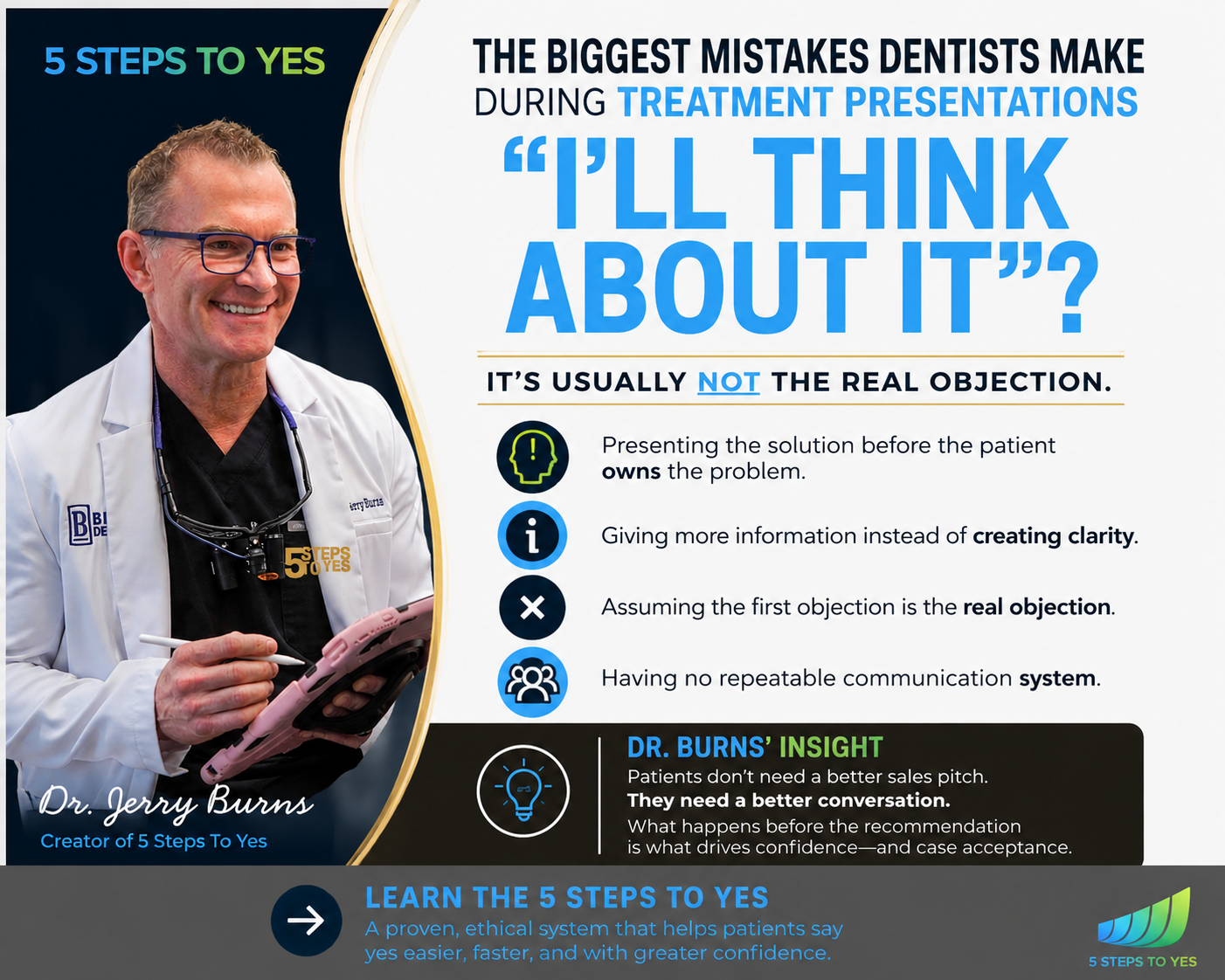
1. Presenting the Solution Before the Patient Owns the Problem
Dentists see the problem immediately. Patients don't.
When treatment is recommended before the patient fully understands what's happening and why it matters, hesitation becomes much more likely.
That's often when we hear:
"I'll think about it."
"Can I wait?"
"I need to talk to my spouse."
Those responses are usually symptoms of the conversation, not the patient's commitment to their health.
2. Giving More Information Instead of More Clarity
When patients hesitate, many dentists instinctively explain more.
More clinical details.
More facts.
More education.
But more information doesn't always create more understanding.
Patients don't need to think like dentists. They need enough clarity to feel confident making an informed decision.
3. Assuming the First Objection Is the Real Objection
When a patient says, "It's too expensive," or "I need to think about it," many dentists immediately start trying to solve that objection.
In reality, those statements are often placeholders for uncertainty.
Responding too quickly can create pressure instead of confidence.
4. Having No Repeatable Communication System
Dentistry has systems for diagnosis, treatment planning, and clinical procedures.
Yet one of the most important moments in the entire patient journey, the treatment conversation, is often left to individual style, personality, or instinct.
When every provider communicates differently, patients experience inconsistency. And when confidence drops, case acceptance often drops with it.
Dr. Burns' Insight
One of the biggest lessons I've learned over the years is that patients usually don't need a better sales pitch.
They need a better conversation.
The difference between a patient saying, "I'll think about it," and confidently moving forward often isn't the treatment itself. It's everything that happened before the recommendation was made.
Unfortunately, that's the part most of us were never taught in dental school.
Free Introduction Training
Ready to turn more “I’ll think about it” into Yes?
See how the 5 Steps to Yes framework helps you build patient trust, create clarity and make case acceptance more predictable.
Start the Free Training